
Change is a normal part of services delivery, but the difficulty is keeping each change connected to the position that was originally agreed.
Procurement is usually closest to an engagement when the requirement is defined, suppliers are compared and the Statement of Work (SOW) contract is signed. What happens after that determines whether scope, cost and outcomes stay aligned, because requirements evolve, priorities shift and suppliers adapt as delivery progresses. Where Procurement maintains a baseline through those changes, services spend moves into managed territory and the function gains a view of how work is actually progressing rather than how it was intended to.
Establish a baseline that can be managed
A Statement of Work should do more than describe what the supplier has been asked to do. It needs to establish:
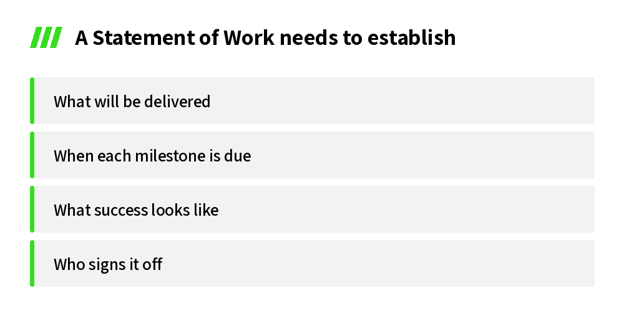
Without that detail there is no reliable way to separate work originally agreed from work added since. With it, Procurement has something concrete to measure delivery against throughout the engagement.
Capture the outcome alongside the cost
A baseline recording only price and duration leaves out the reason the engagement was commissioned. Recording the intended outcome gives a second reference point, so that when a variation is proposed the assessment covers whether it moves the engagement closer to its original purpose as well as what it adds to the cost. That is where Procurement demonstrates value a negotiated rate cannot show on its own.
Assess change at the point it is agreed
Variations are often handled through a conversation, an email and a purchase order increase, with the commercial impact established afterwards. Setting out how changes are raised, assessed and approved allows that impact to be understood when the decision is made rather than when the invoice arrives. It also makes the cumulative position visible, allowing Procurement to raise a conversation about direction while the engagement can still be steered.
Keep variations connected to the engagement
A variation recorded as a separate purchase order loses its link to the scope it belongs to. Held against the engagement itself, variations show:
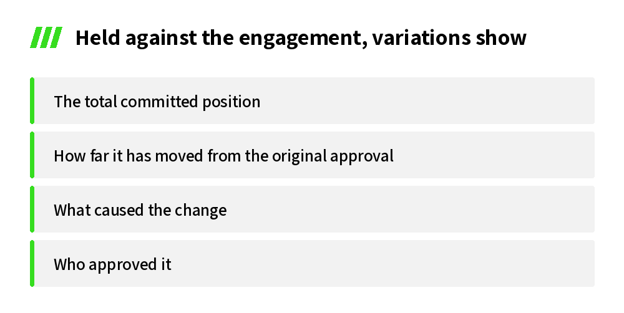
That gives Procurement a defensible account of the position at any point, rather than one reconstructed later from emails and invoices.
Confirm delivery and closure against the baseline
A purchase order shows what was committed, but it cannot show whether the supplier delivered against that commitment. Tracking milestones, acceptance and supplier performance gives an earlier view of an engagement moving away from plan, and a clear end point stops work continuing because nobody has confirmed it should. Maintained consistently, that record informs future sourcing decisions and strengthens negotiating positions at renewal.
Connecting the information that already exists
Most of this information is already generated during a services engagement. The difficulty is that it sits across contracts, purchase orders, project plans and individual knowledge, which makes a connected view hard to assemble while the engagement is running.
A Services Procurement System (SPS) provides that structure, bringing together everything an engagement generates:
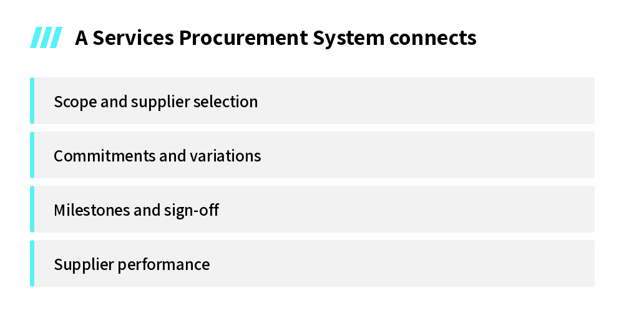
The result is greater spend under management and the opportunity to act while there is still time to influence the outcome. Services stop being the category Procurement sees at the beginning and hears about at the end, and become one where the function can show the business what it committed to, what it received and what that work delivered.