
The Hidden Cost of Outsourced Services No One’s Talking About (and Why We Should be Talking About It)
Here’s a common scenario that plays out in organisations every day:
Your team brings in an outsourced supplier for a big project. But the scope is vague, timelines aren’t clear, and no one knows where the contract is. A few weeks in, deadlines start slipping, costs increase, and expectations blur.
This is one of the hidden costs of unmanaged services procurement. Multiply that across departments, teams, and categories and suddenly, it becomes more than just inefficiency, it becomes a risk to strategy, spend, and performance.
So why aren’t we talking about it?
Because in many organisations, no one truly owns it.
Our Services Procurement Survey 2025 found that only 53% of businesses say Procurement teams have ownership, the other half is fragmented amongst other teams and stakeholders. And with fragmentation comes lack of accountability, visibility and value.
Ownership becomes more complex when the tools do not support the services procurement function:
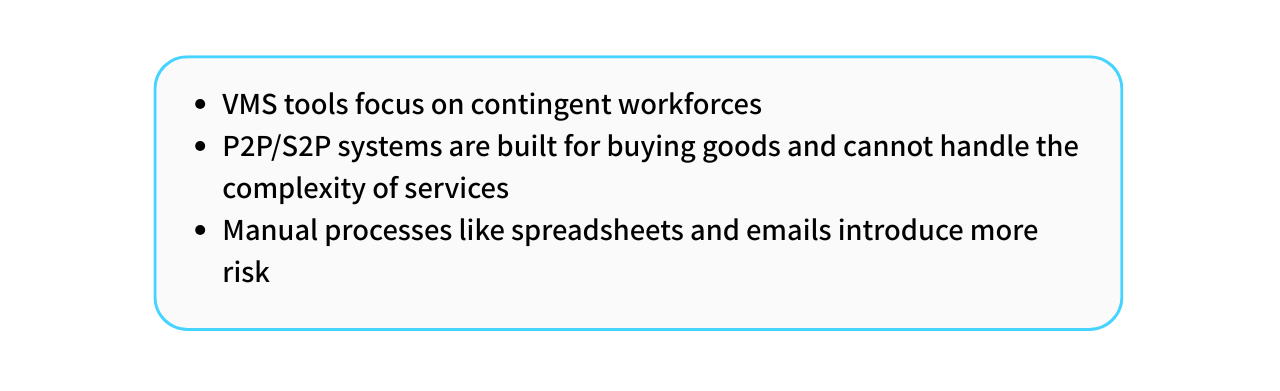
Add to that the wrong KPIs focussing on administrative tasks rather than value delivery and the issue becomes buried and strategic progression stops.
And why should we start talking about it?
Because the business landscape is changing fast and services are key to transformation and growth.
If procurement wants to move from tactical support to strategic enabler, services need the same level of visibility, structure and control as other spend categories. That means:
Making sure suppliers deliver what they promised, being on time, on budget, to spec
Measuring performance, not just cost
Enabling stakeholders with tools that guide best practice, not bypass it
To stay competitive, organisations must ensure that buying critical services is easy, quick, and safe for stakeholders, while driving real value back to the business.
What’s the way forward?
A dedicated Services Procurement System (SPS) that’s built specifically to manage outcome-based work. One that provides control, clarity and confidence at every stage of the full lifecycle.
With an SPS, you can:
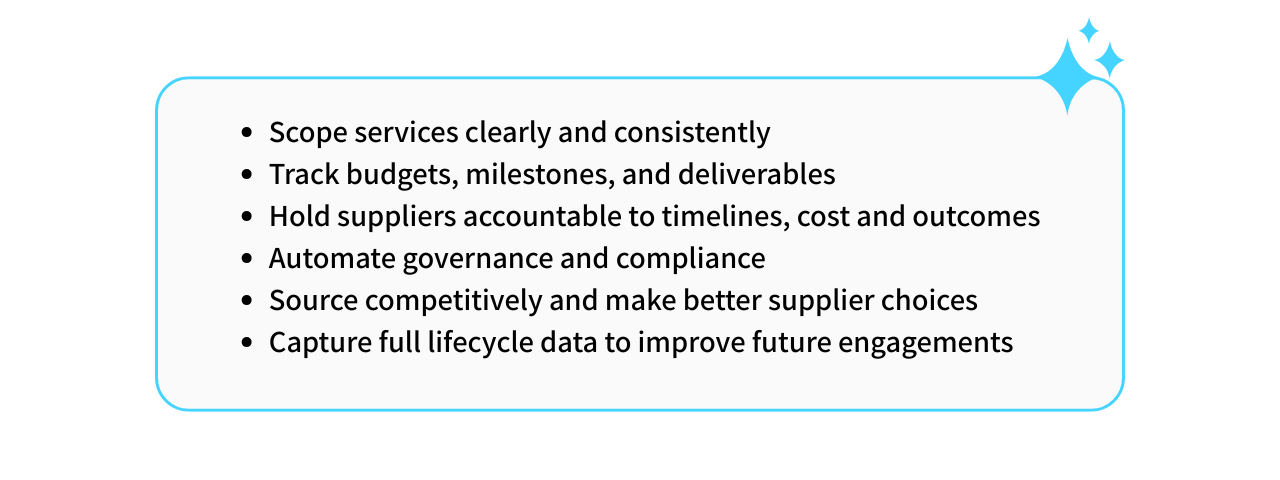
Recognising the costs of unmanaged services procurement in your business is the first step to understanding what needs changing and how to solve it.
Because services procurement doesn’t need to be a blind spot. When managed strategically, it becomes a driver of value, not a source of hidden cost.
If services are part of your business strategy, your systems should treat them that way.