
What is Services Procurement?
Hint - You’re probably already doing it
Procurement enables organisations to meet their needs through goods and services, in order to operate effectively.
If your team has ever hired a creative agency, brought in IT consultants, or outsourced a transformation project, you’ve already done services procurement.
The challenge is that services procurement is not often recognised as a formal category. Without this clarity, it makes it harder to take ownership, manage and utilise.
So… What is services procurement?
Services procurement is the process of sourcing, contracting, managing, and measuring the work of external suppliers that deliver outcome-based services. From consulting firms to creative agencies, these services are often project driven and structured through a Statement of Work (SOW).
With so many services now delivered by external providers, getting this process right is key to ensuring value, compliance, and control.
How does services procurement benefit businesses?
Organisations today rely on external service providers to access specialised skills, scale quickly, and deliver projects with greater speed and flexibility, especially as priorities shift and resources tighten.
But when managed strategically, services procurement isn’t just a way to fill gaps, it becomes a way to deliver on business goals faster, respond confidently to change, and gain competitive advantage through smarter sourcing and supplier partnerships.
How it’s different (and more complex)
Services and goods follow completely different procurement lifecycles.
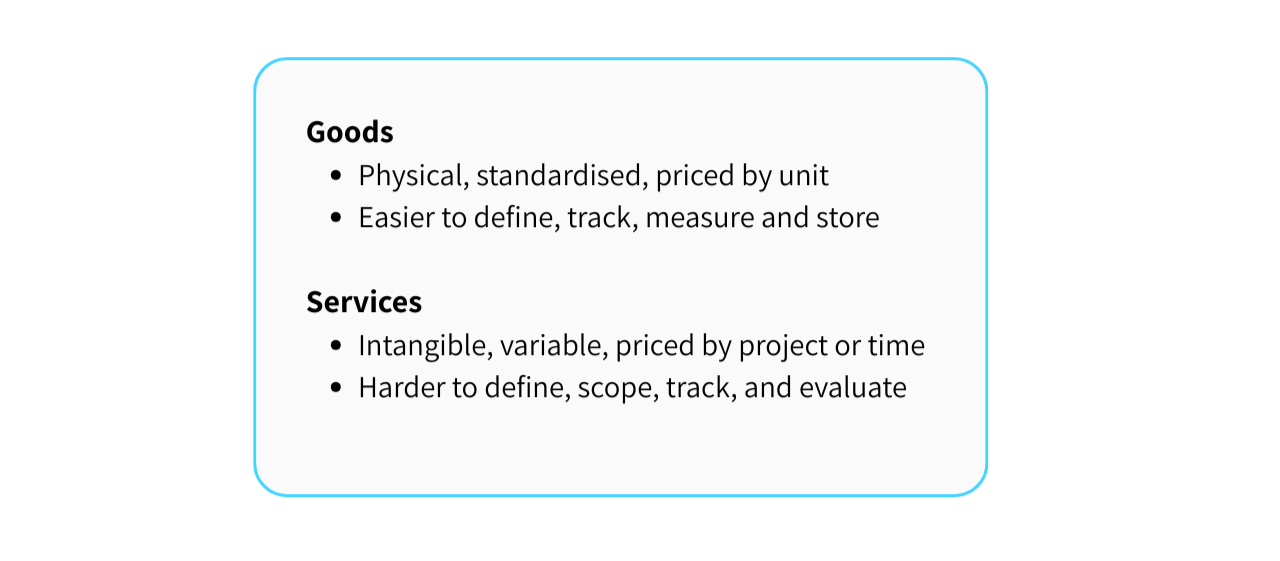
However, most organisations still try to manage these contrasting lifecycles with the same generic tools.
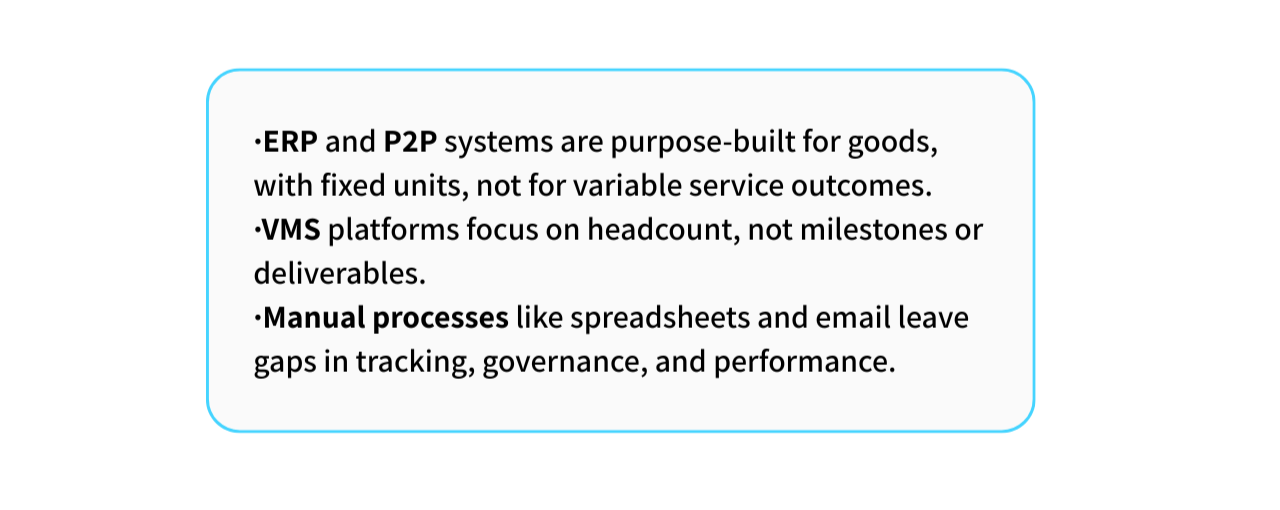
With only 53% of companies saying Procurement holds responsibility for services, and many still relying on outdated tools, businesses are struggling to gain visibility and control and losing value as a result.
Why services shouldn’t be an afterthought
Services are no longer just support functions, they are strategic drivers of change, growth, and innovation.
Business process outsourcing is projected to grow by over 9% each year through 2030, meaning more services, more suppliers, and more at stake. Without the right approach, this complexity can lead to missed savings, unmanaged risk, and limited visibility.
As outsourcing increases, so does the need to treat services procurement with the same attention and structure as any other major category.
Solving services procurement
Recognising services as a category is the first step to turning services procurement into a strategic advantage, followed by an understanding of the challenges faced by procurement teams.
Managing services well means more than cutting costs. It’s about improving outcomes, reducing risk, and giving the business confidence that it’s getting real value from every engagement.
But this can’t be achieved through tools designed for goods, or processes built around headcount. Services requires a system that is purpose-built for its complex nature.
That’s where a dedicated approach, like a Services Procurement System (SPS), comes in. Built specifically for managing project-based, outcome-led work, an SPS helps bring visibility, control, and accountability across the entire services lifecycle, from sourcing to delivery.
As services continue to shape how businesses grow and transform, having the right foundation to manage them is no longer a nice-to-have, it’s essential.