
Spend under management is one of the clearest measures of procurement influence. Third-party services are where the least of it follows a defined process.
Our 2026 Services Procurement Survey found that 54% of organisations place responsibility for third-party services spend with Procurement, while 38% report that it's not centrally managed at all. For Procurement that creates an uncomfortable position, accountable for a category it often sees late and has limited opportunity to influence.
It starts with knowing what is already running
Procurement needs a picture of the third-party services already underway, including which suppliers are engaged across the business, what has been committed against them and which engagements nobody is formally tracking.
That picture produces the baseline every later improvement is measured against, and it tends to surface duplicate suppliers and overlapping scopes that can be acted on straight away.
Self-service decides how much work comes through the process
Teams go around Procurement at the point external services are requested, because the route feels time-consuming, the scope is difficult to write and the supplier they used last time is familiar enough to be the default. Little data exists on the wider supplier market, on what similar work has cost elsewhere in the business or on how any of those suppliers have performed, so there is nothing to weigh that choice against.
Self-service changes that by letting a business user raise the work themselves. Where they can describe the need in their own words and get a clear scope back, with the right questions asked and suppliers suggested against it, the reason for going direct largely disappears:
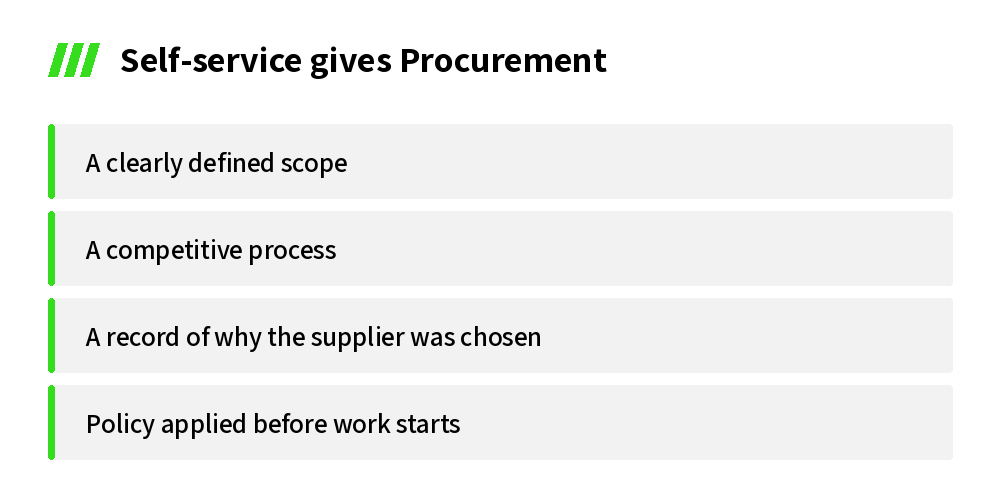
That protects the commercial position as well as the process, with UK public procurement data showing single-bid tenders to be around 7% more expensive than those attracting more than one bid.
Most of what matters happens after the contract
Scope is revised, milestones are met or missed, variations are agreed and invoices arrive against work that may no longer match the original scope.
The same self-service route can carry on through delivery, with the business approving milestones, raising variations and seeing invoices against the engagement within permissions the organisation sets. That keeps the record current in the hands of the people closest to the work, and leaves Procurement looking at the live position rather than a historic one:
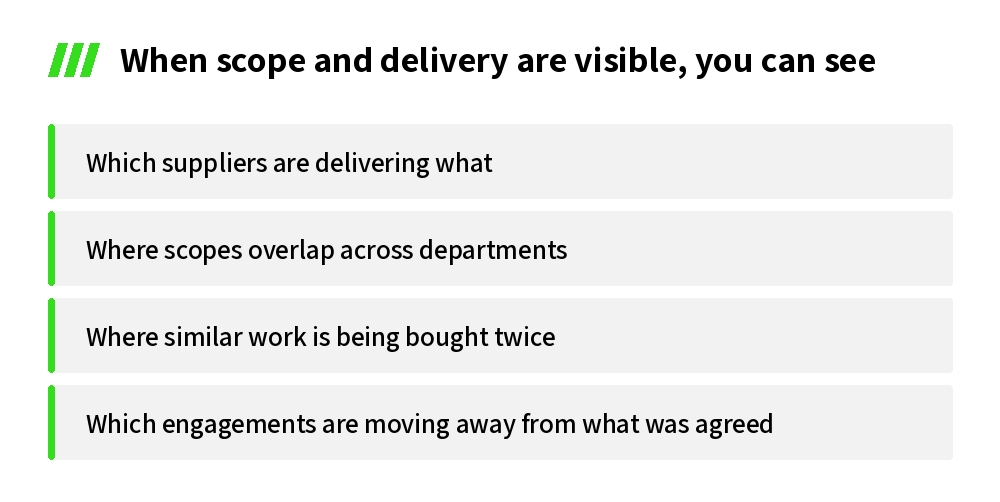
Where it sits across separate documents, spreadsheets and inboxes, piecing that together falls to Procurement, chasing stakeholders for information that should already exist.
The record becomes useful the longer it runs
Each engagement handled this way adds to something Procurement can act on. Repeat suppliers become visible across departments, and how a supplier performed on earlier work becomes evidence the next time similar work goes out to bid, instead of an impression.
What has been committed, and how far a figure has moved since it was approved, also come from one place instead of several. That matters most when the question arrives from the board or an auditor, and it gives Finance a current position to plan against rather than an approved figure that has since moved.
Bringing it into one place
A Services Procurement System (SPS) supports each of these steps, combining self-service for the business with the governance Procurement needs and holding scope, sourcing, approvals, variations and supplier performance together.
The result is more third-party services spend following a defined process, with the visibility to manage it and the evidence to show what it delivered.